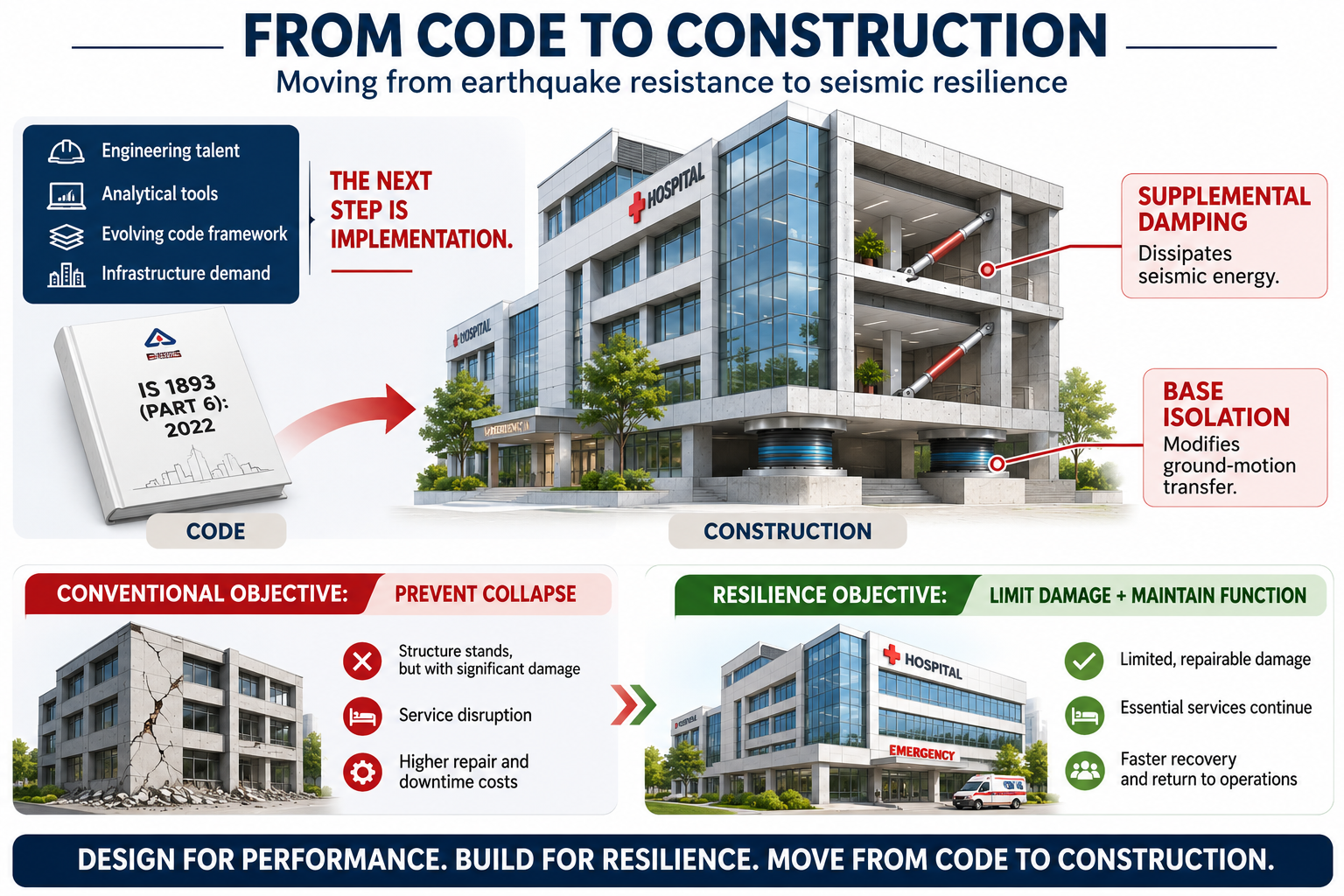
Moving beyond conventional earthquake resistance towards performance, damage control and resilient infrastructure
When an earthquake strikes, a building that does not collapse is often considered a success of engineering. But is preventing collapse enough?
What if the building remains standing but its services stop functioning, its critical equipment is damaged, or its occupants cannot safely return? Structural survival does not always translate into operational resilience.
Therefore, buildings should be designed not only to withstand earthquakes, but also be engineered to minimise damage and remain functional after the shaking stops.
India's approach to earthquake-resistant design is entering an important phase. The publication of IS 1893 (Part 6): 2022, Guidelines for Criteria for Earthquake Resistant Design of Structures, Part 6: Base Isolated Buildings, created a dedicated Indian framework for designing base-isolated buildings. The broader IS 1893 series is also evolving, with building-specific provisions now being addressed under IS 1893 (Part 5).
Technologies such as base isolation and supplemental damping can play an important role in this transition. Instead of relying exclusively on the strength and ductility of the structural system to resist earthquake forces, these technologies aim to modify its dynamic response. They do this either by isolating the structure from damaging ground motion or by dissipating a significant portion of the energy generated during an earthquake.
For India, however, having the technology and having a code are only the beginning. The real challenge is to move from code to construction, creating an ecosystem in which seismic protection technologies are understood, designed, specified, tested, installed, inspected and maintained with confidence.
Conventional seismic design is fundamentally based on a controlled-damage philosophy. A structure is provided with adequate strength, stiffness and ductility while certain structural members are permitted to undergo inelastic deformation during severe earthquake shaking. Through appropriate capacity design and ductile detailing, the intention is to prevent brittle failure and catastrophic collapse.
This philosophy has saved lives and remains fundamental to earthquake engineering.
However, preventing collapse does not necessarily mean ensuring continued functionality.
After a strong earthquake, a building may remain standing while suffering damage to structural components, partitions, façades, services, ceilings, equipment and other non-structural systems. A hospital that does not collapse but cannot operate, or a data centre whose structure remains safe while critical equipment is damaged, cannot necessarily be regarded as a fully resilient structure.
This distinction is particularly important for critical infrastructure and essential facilities, where the ability to remain operational after an earthquake is just as important as structural safety.
The official BIS guidance for IS 1893 (Part 6) makes this philosophical shift particularly clear. Unlike conventional earthquake-resistant design, where damage is expected in selected structural members, base isolation aims to reduce the extent of damage. The intent is not simply construction-cost reduction but minimising damage to both the building and its contents while enhancing the likelihood of continued functionality.
This is where seismic isolation and energy-dissipation technologies become especially relevant.
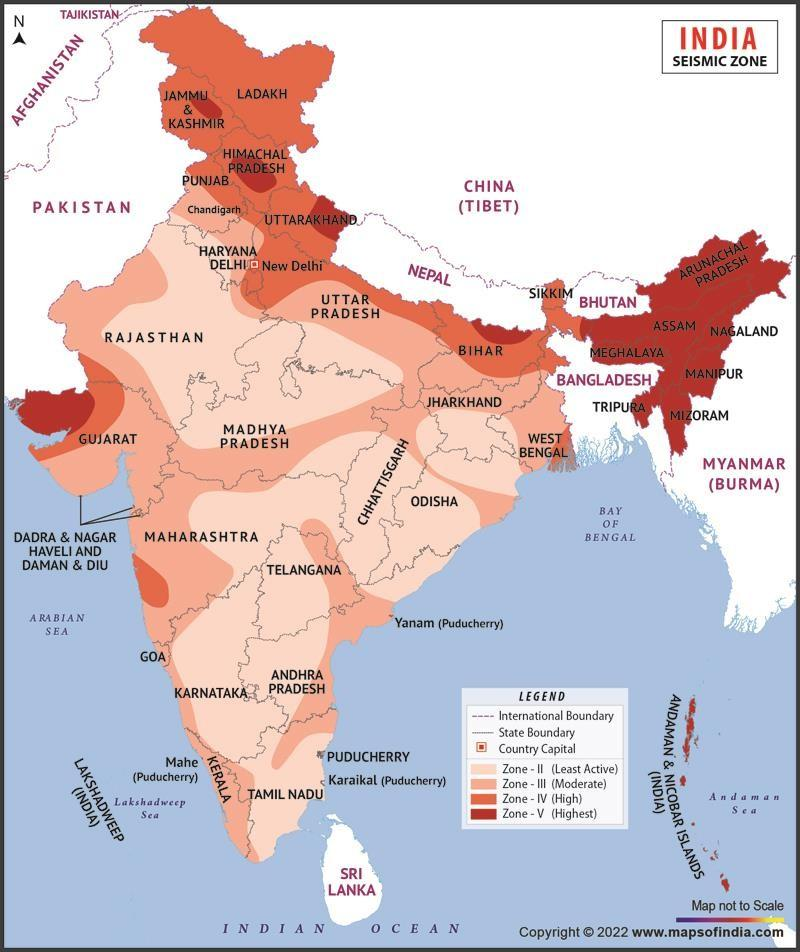
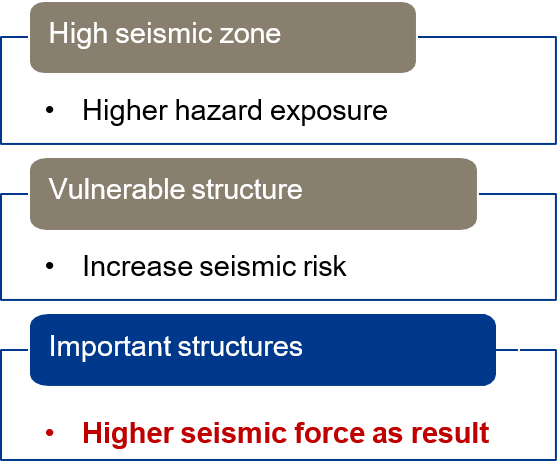
Fig. 1: India's seismic risk is shaped by the interaction of seismic hazards, structural vulnerability and exposure of critical infrastructure.
Imagine a building firmly connected to the ground. During an earthquake, ground movement is transmitted through the foundation into the structure. The building's mass generates inertia forces, producing storey shear, deformation and acceleration.
Base isolation changes how these forces are transferred to the building.
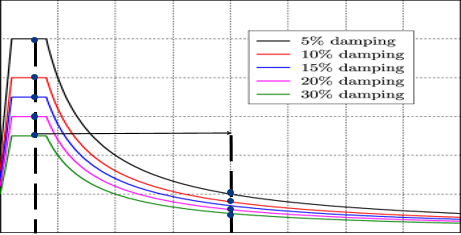
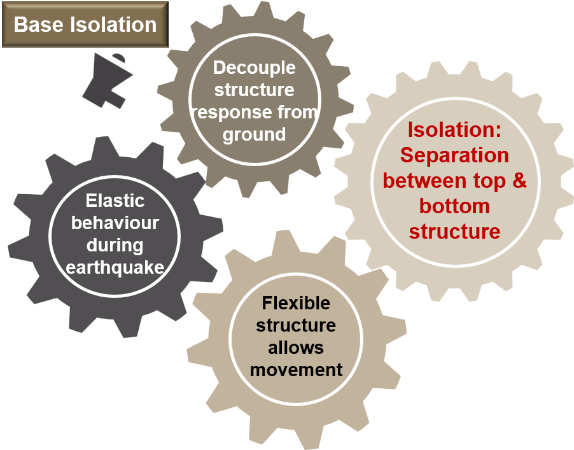
An isolation system introduces a horizontally flexible interface, generally between the foundation/substructure and superstructure. By adding flexibility, the isolation system lengthens the structure's period.
Reducing the lateral stiffness of the isolated system therefore increases its effective period. Isolation can consequently shift the structure away from the region of the response spectrum where acceleration demand may be high. The extent of this reduction depends on the characteristics of the ground motion and the isolation system.
Fig. 2: Base isolation modifies a building's response to earthquake motion by introducing flexibility and increasing its effective natural time period.
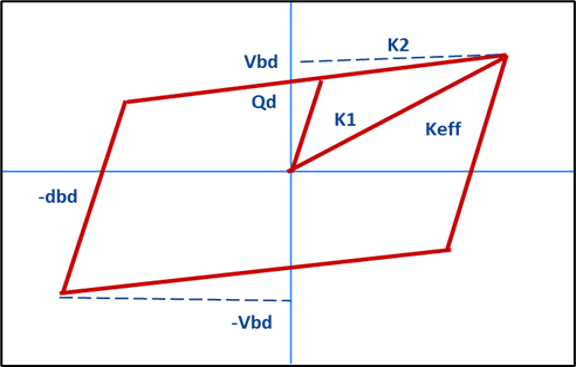
Research and engineering literature commonly describe this combination of period elongation and controlled energy dissipation as the fundamental basis of seismic isolation.
Common Isolation Technologies
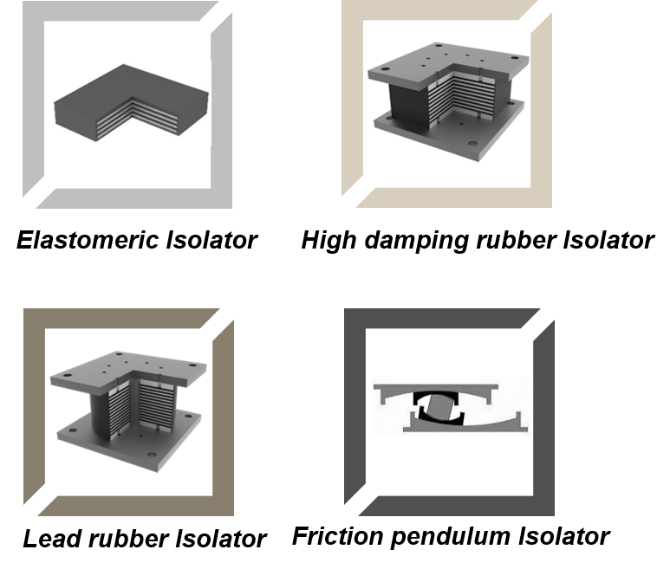
Different isolation technologies achieve this behaviour through different mechanisms.
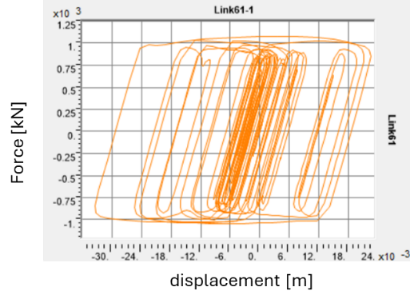
Fig. 3: Different types of seismic base isolators and hysteresis behaviour of an isolation system.
Modern seismic isolation designs may also use combinations of bearings, sliders and damping devices depending upon the required performance.
The attraction of base isolation lies not simply in lowering a calculated base shear. Its greater value is the possibility of changing the entire response profile of the building.
Potential Performance Benefits
The isolation layer itself may undergo substantial horizontal displacement. The structure must explicitly accommodate this displacement through seismic gaps, utility connections, stairs, lifts, façades, entrances and adjacent construction.
This is why isolation should be treated as a building system, rather than simply as a bearing inserted beneath columns.
While base isolation primarily modifies the dynamic characteristics of a structure, supplemental damping takes a different approach: dissipating earthquake-induced energy before that energy produces damaging structural response.
A simple conceptual representation of viscous damping is:
F = C × |v|α
Where:
The actual response and modelling requirements depend on the selected device.
Common Damping Technologies
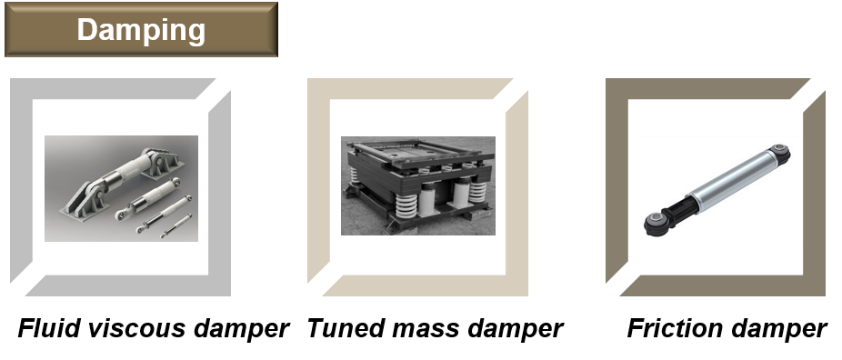
Fig. 4: Different damping technologies dissipate earthquake-induced energy to help control structural vibrations and response.
Other vibration-control approaches include tuned mass dampers and active or semi-active systems, although their applications, control objectives and design philosophies differ from conventional supplemental energy-dissipation devices.
A major obstacle to wider adoption of emerging structural technologies is uncertainty.
This is where a dedicated national standard becomes important.
IS 1893 (Part 6): 2022 provides Indian guidelines for the design of base-isolated buildings. Its provisions cover the estimation of design lateral force and displacement, general requirements for the isolation system, and analysis methods including equivalent static and response-spectrum approaches.
While this standard provides a foundation for the design of base-isolated buildings, there is also a need for more detailed guidance on step-by-step design methods, qualification and assessment criteria, dynamic testing and installation measurements to ensure passive control devices perform reliably.
The Bureau of Indian Standards lists IS 1893 (Part 6): 2022 as an active standard under Technical Committee CED 39.
At the same time, India's broader earthquake-resistant design framework has undergone a significant restructuring. IS 1893 (Part 5): 2025 now specifically addresses buildings as part of the seventh revision of the IS 1893 framework. Its foreword highlights India's significant seismic exposure and the need to incorporate developments and research in earthquake-resistant design.
For the engineering community, this is more than a rearrangement of code clauses. It creates an opportunity to move the conversation towards performance, functionality and resilience.
Why Adoption in India Still Needs to Accelerate
Codes are necessary, but they do not automatically create construction practice.
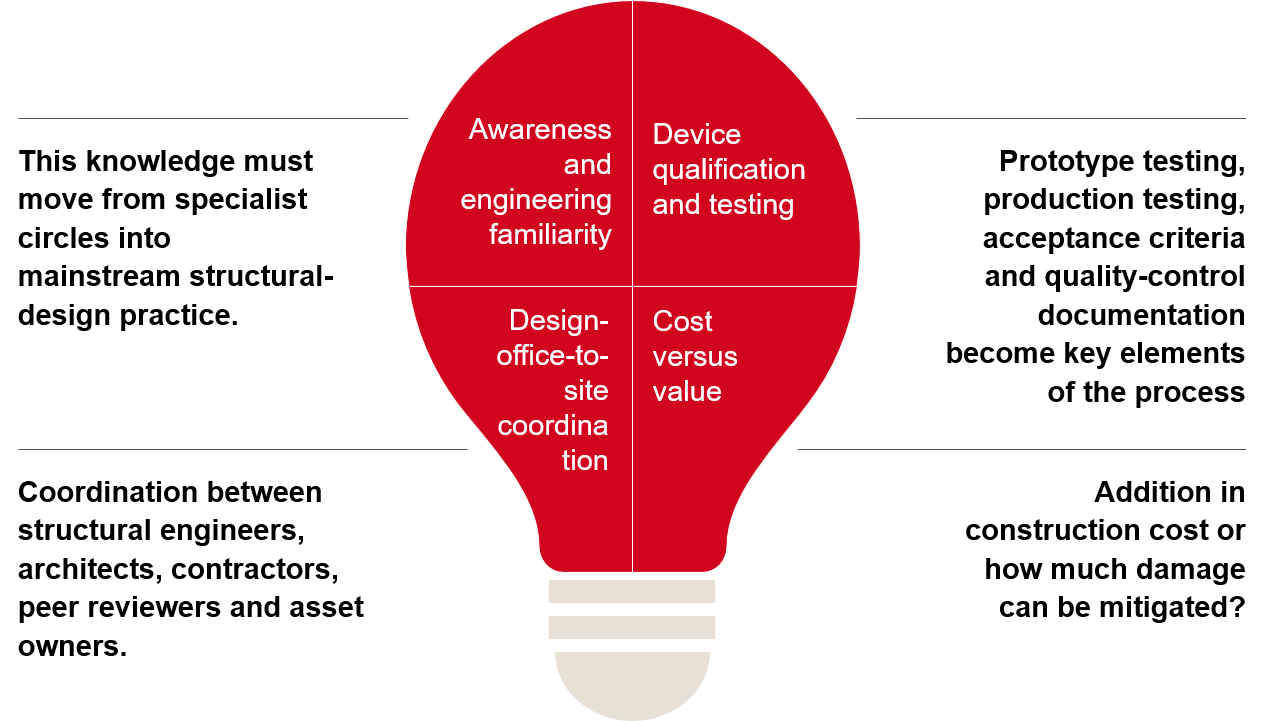
For seismic protection systems to become mainstream, several interconnected barriers must be addressed, including:
Fig. 5: Bridging the gap between seismic design innovation and its widespread adoption in India's construction industry.
The economic question should not be restricted to:
"How much does the isolation or damping system add to the construction cost?"
A more meaningful question is:
"How much damage, downtime and loss of function can the system prevent over the life of the asset?"
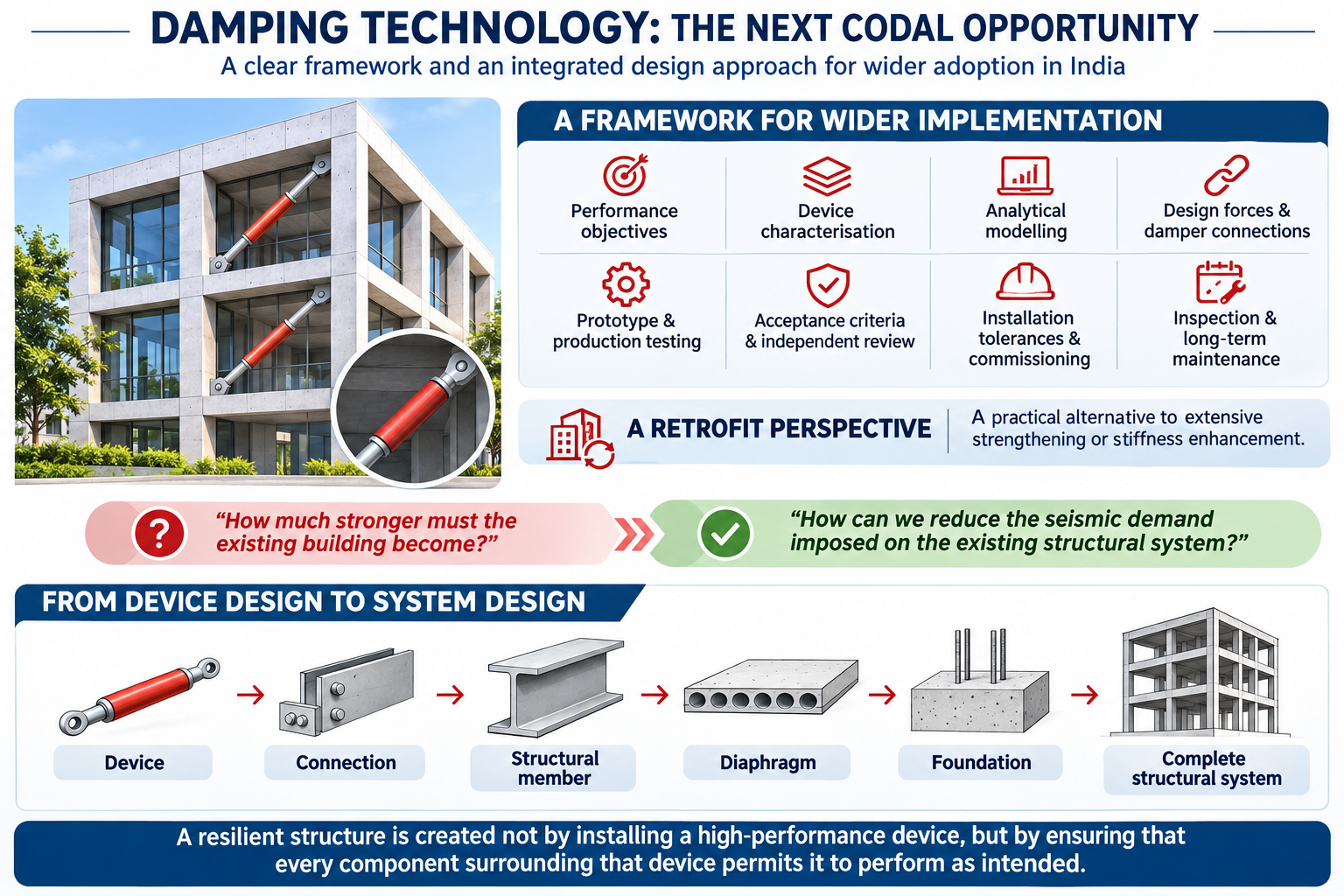
Fig. 6: Damping systems in India require a clear framework, coordinated design and reliable integration of every structural component.
While a dedicated Indian standard now establishes a pathway for base-isolated buildings, the broader adoption of supplemental damping deserves similar attention.
India already has the engineering knowledge and analytical capability to design structures incorporating energy-dissipation systems. What is needed to support their wider implementation is a clearer framework addressing:
This becomes particularly important for retrofitting existing structures, where damping can offer an alternative to extensive strengthening or stiffness enhancement.
Rather than only asking "How much stronger must the existing building become?", engineers can increasingly ask:
This represents an important shift in seismic retrofit philosophy, moving the focus from strengthening the structure alone to controlling the response and managing the energy introduced during an earthquake.
From Device Design to System Design
One of the most important lessons for practical adoption is that neither an isolator nor a damper works independently. A viscous damper producing a large force requires a reliable load path through its brace, connections, gusset plates, beams, columns and foundations.
Similarly, an isolation bearing transferring gravity load while accommodating large cyclic lateral movement requires careful consideration of the interfaces above and below the bearing.
Design therefore needs to address:
A resilient structure is created not by installing a high-performance device, but by ensuring that every component surrounding that device permits it to perform as intended.
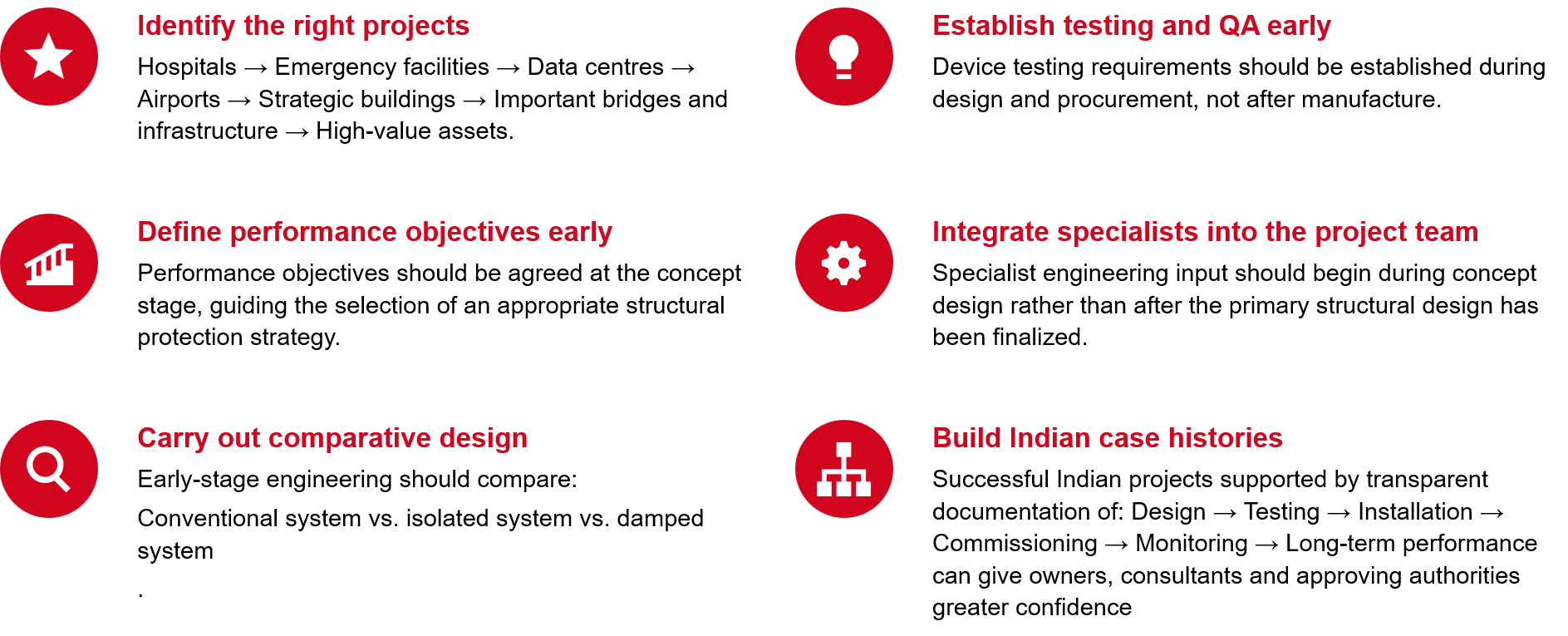
The transition from specialist use to mainstream engineering practice will require coordinated action across the construction and infrastructure sectors.
Fig. 7: Mainstreaming seismic protection systems requires early planning, clear performance objectives, rigorous testing and coordinated industry expertise.
Key Priorities for the Indian Construction Industry
Develop comprehensive design provisions, performance requirements and practical guidance for the implementation of isolation and supplemental damping systems.
Expand access to reliable testing facilities for prototype qualification, production testing and acceptance verification.
Encourage specialised training and collaboration among structural engineers, academic institutions, manufacturers and design consultants.
Support quality-controlled manufacturing capabilities and reliable supply chains for seismic protection devices.
Implement pilot projects in hospitals, educational institutions, emergency facilities and other critical infrastructure to demonstrate practical benefits.
Ensure that seismic protection systems are inspected, documented and maintained throughout the building's operational life.
The evolution of seismic design can be understood through a broader progression:
Seismic resilience cannot be measured only by whether a structure remains standing after an earthquake. For critical infrastructure, the more meaningful question is whether the building remains safe, usable and capable of serving the community when it is needed most.
IS 1893 (Part 6): 2022 is therefore an important step. It provides a formal Indian framework for base-isolated buildings and explicitly recognises the value of reducing damage and improving the likelihood of continued functionality.
However, there remains a need for more detailed guidance in terms of design processes, qualification and testing, and installation to ensure end-to-end performance.
The evolving IS 1893 framework can now help stimulate a wider discussion among designers, academics, policymakers, manufacturers, project owners and construction professionals about where advanced seismic-protection technologies should form part of normal engineering practice.
Fig. 8: From earthquake survival to reduced damage, continued functionality and resilient infrastructure through smarter seismic design.
India has the engineering talent, analytical tools, growing code framework and infrastructure demand required for wider implementation of advanced seismic-protection systems.
Base isolation changes how earthquake motion is transmitted to a building, while supplemental damping systems dissipate seismic energy to help control its structural response. When appropriately designed and implemented, both technologies offer engineers a way to move beyond conventional life-safety objectives towards reduced damage, continued functionality and greater resilience.
The question for India's engineering community is no longer simply whether a building can withstand earthquake shaking without collapsing. It is whether it can emerge from a major earthquake with limited damage, protect its occupants and contents, remain functional and allow essential services to continue.
Design for performance. Build for resilience. Move from code to construction.
From Code to Construction: Mainstreaming Base Isolation and Damping Systems in India
1. From Earthquake Resistance to Seismic Resilience
2. Base Isolation: Changing How the Building Responds
Combine laminated rubber and steel layers with a lead core. The rubber provides horizontal flexibility and restoring capability, while the lead core yields during earthquake movement, helping dissipate energy.
Use specially formulated elastomeric material that provides horizontal flexibility together with inherent damping.
Permit controlled movement through sliding interfaces. Pendulum-type friction systems additionally use their geometry to provide restoring capability, helping the structure return towards its original position after displacement.
3. What Base Isolation Can Achieve

Important Engineering Trade-Off
Base isolation does not eliminate earthquake movement. It redistributes where the movement occurs.
4. Damping Systems: Dissipating Earthquake Energy
Viscous Damper Force:
These use a secondary mass tuned to the structure's natural frequency to counteract motion and reduce structural response.
These dissipate energy through controlled frictional sliding. Their design requires careful consideration of slip load, connection behaviour and cyclic performance.
These rely on deformation of viscoelastic material to convert part of the mechanical energy into heat and can also provide additional stiffness depending upon their configuration.
These dissipate energy through the movement of fluid within a specially designed mechanism, with damping forces generally dependent on relative velocity.
5. The Significance of IS 1893 (Part 6)
Key Engineering Questions
How should they be analysed? What performance is required? How should devices be tested? What should the approving engineer verify?
 The Economic Perspective
6. Damping Technology: The Next Codal Opportunity
"How can we reduce the seismic demand imposed on the existing structural system?"
Device → Connection → Structural Member → Diaphragm → Foundation → Complete Structural System
7. A Roadmap for Mainstreaming Adoption in India
 1. Strengthen Design Guidelines
2. Develop Testing and Qualification Infrastructure
3. Build Technical Expertise
4. Promote Domestic Manufacturing
5. Encourage Demonstration Projects
6. Establish Inspection and Maintenance Practices
8. Building a Culture of Resilience
Resist the Earthquake → Control the Response → Limit Damage → Maintain Functionality → Recover Rapidly
9. From Code to Construction
 Resilience is not just about surviving an earthquake. It is about being able to function when the shaking stops.
Acknowledgement:
Agamoni Das
Head- Codes & Approvals, Hilti India
Leave a Comment